Syla vs. Koinly
Koinly or Syla? Which crypto tax software has everything you need to calculate and file your crypto taxes with the ATO easily?
We’re comparing two of the leading platforms for Australian crypto taxes: Koinly and Syla. We’ll look at tax accuracy, integrations, automations, and portfolio tracking to see which crypto tax calculator works best for you.
| Koinly | Syla | |
|---|---|---|
| Free plan | ✔ with all features included excluding downloading your tax report | ✔ with limited features |
| Cheapest plan | $69 AUD per year | $49 AUD per year |
| Payment options | Credit, debit, crypto | Credit or debit |
| Integrations | 1000+ | 500+ |
| Free portfolio tracking | ✔ | ✔ |
| NFTs | ✔ | ✔ |
| TurboTax, TaxAct | ✔ | ✔ |
| DeFi | ✔ | ✔ |
| Margin trading | ✔ | ✔ |
| Futures, options, and other CFDs | ✔ | ✔ |
| Loans | ✔ | ✔ |
| ATO tax forms | ✔ | ✔ |
| International tax reports | ✔ | ✘ |
| Free tax loss harvesting tool | ✔ | ✘ |
| Expert review | $499 - $1,999 depending on season | ✘ |
Integrations
| Koinly | Syla | |
|---|---|---|
| All integrations | 1,000+ | 500+ |
| Supported exchanges | 450+ | 430+ |
| Supported wallets | 220+ | 30+ |
| Supported blockchains | 290+ | 20+ |
| Auto-sync integrations (API) | 500+ | 45+ |
More native support for your wallets, exchanges, or blockchains equals less manual work involved in calculating your crypto taxes.
When it comes to integrations, Koinly comes out on top with over 1,000 total integrations, including more than 500 auto-sync (API) integrations, so most users can sync their accounts without handling any CSVs.
Syla has a wide range of integrations and API integrations for major exchanges, but a vast majority of their support requires you to manually import CSVs.
Portfolio tracking
| Koinly | Syla | |
|---|---|---|
| Portfolio tracking dashboard | ✔ | ✔ |
| View unrealized gains and losses | ✔ | ✔ |
| Individual holdings breakdown and ROI | ✔ | ✔ |
| View real-time market data | ✔ | ✔ |
Both tools offer in-depth portfolio tracking on dashboards that monitor performance, holdings, gains, and ROI at a glance, as well as information boxes to help you further understand what you’re looking at.
The difference between the two comes down to UI and user experience. Koinly’s dashboard interface is cleaner, including a graph to easily identify the real-time market value of your holdings, and an automatic filter to hide spam tokens from view. These features contribute to a more polished dashboard overview.
DeFi, NFTs, margin trading, and derivatives
| Koinly | Syla | |
|---|---|---|
| DeFi | ✔ | ✔ |
| Margin trades | ✔ | ✔ |
| Futures, options, and other derivatives | ✔ | ✔ |
| Mining & staking | ✔ | ✔ |
| Lending | ✔ | ✔ |
| Airdrops | ✔ | ✔ |
| NFTs | ✔ | ✔ |
Both Koinly and Syla support all transaction types, including NFTs, mining, staking, airdrops, and DeFi.
Where Koinly stands out is with their dedicated NFT dashboard, which allows you to view your NFTs and see your total estimated value, cost basis, and unrealized gains/losses.
Koinly also has automatic spam token filtering, whereas Syla places the onus on the user to manually filter out each spam transaction, which can quickly become a time-consuming process.
Free plan
| Koinly | Syla | |
|---|---|---|
| Rich transaction detail | ✔ | ✔ |
| Tax summary preview | ✔ | ✘ |
| Tax loss harvesting tool | ✔ | ✘ |
| Portfolio tracking | ✔ | ✔ |
Both Koinly and Syla offer a free plan with up to 10,000 transactions, but Syla’s plan is very limited. Key features such as tax summary previews and tax loss harvesting are locked behind a pay plan.
With Koinly, all of these features are free. You can preview a full tax summary to understand your gains, losses, and income (excluding Canada), explore NFT performance, and simulate trades with a free tax loss harvesting (tax optimization) tool to ensure you’re happy with your calculations before upgrading.
Usability and features
| Koinly | Syla | |
|---|---|---|
| Easy to use, without compromising functionality | ✔ | ✔ |
| Automatic error detection | ✔ | ✔ |
| Supported transaction types | ✔ | ✔ |
| Transaction filters | ✔ | ✔ |
| Customizable tax settings | ✔ | Only on paid plans |
It's easy to import, filter, and review transactions on both platforms, with support from tags and automatic error detection.
Where Koinly stands out is its visibility, support, and guidance for users. Although both platforms detect issues that may affect your taxes, Koinly flags these errors at a wallet level, makes it clearer to see what those errors are, and provides help center articles to help users quickly identify, understand, and resolve issues.
Syla’s error detection is more discreet with a pale yellow notification on each transaction, prompting you to either hover over the notification or click into the transaction manually to see the issue. They also do not provide any links to support users in fixing these issues.
Koinly is also better at filtering out spam tokens that occur in your transactions, saving you time from having to manually classify each transaction as spam.
Finally, Koinly offers customizable tax settings, allowing users to choose between allowable cost basis methods to optimize their tax liability. Syla also offers this, but only on plans starting from $249 per year.
Customer support
Both Koinly and Syla have great scores on Trustpilot, with 4.6 and 4.7 stars, respectively. But Koinly is far more established, with over 2,000 reviews, whereas Syla has just over 30 reviews to date.
Support for both platforms can be found through their help centers, live chat services, and email support. Koinly has a more defined community through its discussion forum.
Koinly also offers an expert review service, which involves a product expert going through your data to ensure everything has been imported correctly, your transaction data is clean, and you are able to produce an accurate tax report.
Syla does not offer this service at this time, so it’s on users (or their accountants) to import and reconcile their transaction data correctly.
Reputation and security
Out of the two, Koinly is the more established platform, founded in 2018, 3 years before Syla. Both platforms have well-established partnerships with leading names in Australia. Syla’s partnerships include CoinSpot, BTC Markets, Binance Australia, and Wayex. Koinly has Australian and global partners, including Coinbase Australia, Binance, CoinSpot, CoinJar, and more.
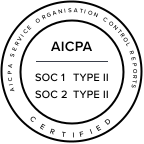
Koinly and Syla handle sensitive financial data, so security is a critical consideration in choosing the right crypto tax software for you. Koinly is SOC 2 and ISO 270001 certified, and its FIFO methodology is accurate and aligns with the guidance set out by the Australian Tax Office.
Syla is ISO 270001 certified and backed by the Australian Tax Office.
Neither platform has experienced any direct data breaches to date.
Supported countries
| Koinly | Syla | |
|---|---|---|
| USA IRS reports (inc TurboTax) | ✔ | ✘ |
| Canada CRA report | ✔ | ✘ |
| UK HMRC report | ✔ | ✘ |
| Australia ATO report | ✔ | ✔ |
| European reports | ✔ | ✘ |
Syla only serves Australian investors, while Koinly offers international support with dedicated reports for more than 10 countries, support for popular tax apps like TurboTax and TaxAct, and a variety of other tax reports that can help investors globally file their crypto taxes easily.
Koinly offers more support for Australian investors, giving them the option to choose between FIFO, LIFO, and HIFO accounting methods across all plans (including free plans). Syla also allows users to change their cost basis method, but only on plans starting at $249 a year, meaning free accounts and the first two tiers of Syla plans can only use FIFO.
Koinly’s myTax report for Australian investors makes it as simple as possible to file your crypto taxes using the ATO’s free myTax service.
Conclusion: Which is better?
Overall, Koinly and Syla are solid options for handling your crypto taxes in Australia. But if you’re looking for crypto tax software with more capability, more integrations, and automatic integrations, and a detailed tax summary to understand your liability before spending, Koinly comes out on top. Although we may be a little biased, we’ll continue to work hard to keep our product that way.