Crypto Chart Patterns Guide
Crypto chart patterns can help investors identify opportunities to buy and sell. Learn about the most common crypto chart patterns and how to interpret them.
Chart patterns are recurring formations on price charts used to predict future price movements; they reflect market psychology and trader behavior.
Patterns are categorized as bullish (e.g., hammer, morning star), bearish (e.g., shooting star, evening star), or continuation (e.g., doji, three black crows).
Pattern reliability depends on context and volume; they are helpful but not foolproof and can be subjective or affected by external events.
What are chart patterns in crypto?
Crypto chart patterns are visual formations created by the price movements of an asset over time. These patterns are used in technical analysis to predict future price movements based on historical data. Traders look for these recurring shapes on price charts to make decisions about when to buy, sell, or hold a cryptocurrency.
For this guide, we’ll be focusing on candlestick patterns, as these are the most common types of crypto charts used. Like above, candlestick chart patterns are specific formations created by a group of candlesticks (each representing price movement over a set time, like 1 hour or 1 day) on a chart. However, unlike general chart patterns (like triangles or head-and-shoulders), these focus more on individual candles or short sequences that signal potential price reversals or continuations.
Read next: How to Read Crypto Charts
Types of candlestick patterns
There are three main categories of chart patterns:
1. Bullish reversal patterns
(Price might go up after appearing)
Hammer: Small body, long lower wick. Found at the bottom of a downtrend.
Bullish engulfing: A large green candle fully covers the prior red candle.
Morning star: Three candles: red → small candle (gap) → strong green.
Piercing line: A green candle opens below the red one but closes over halfway into it.
2. Bearish reversal patterns
(Price might go down after appearing)
Shooting star: Small body, long upper wick. Found at the top of an uptrend.
Bearish engulfing: A large red candle swallows the previous green one.
Evening star: Green candle → small candle (gap) → strong red candle.
Dark cloud cover: A red candle opens above the green one but closes deep into it.
3. Continuation patterns
(Price might continue in the same direction)
Doji: Open and close are nearly equal, signaling indecision. Alone, it’s neutral, but context matters.
Three white soldiers: Three strong green candles. Bullish continuation.
Three black crows: Three strong red candles. Bearish continuation.
Are chart patterns reliable?
Chart patterns are not magical signals or crystal balls. Instead, they’re grounded in market psychology. Every time buyers and sellers interact, their decisions are reflected in the price.
Over time, certain behaviors repeat themselves: fear at the top, panic at the bottom, hesitation before a breakout. These recurring emotional reactions create recognizable shapes on a chart: triangles, flags, head and shoulders, and so on.
In essence, chart patterns visualize crowd behavior, and in markets driven by emotion (like crypto), that’s a powerful insight.
Why traders trust chart patterns
Many chart patterns have been studied extensively and show statistical tendencies to behave in certain ways. For example, a bull flag often results in an upward breakout, while a double top frequently signals a bearish reversal.
Chart pattern analysis can also work as a self-fulfilling prophecy, because thousands of traders recognize and act on the same patterns, their collective behavior can actually make the pattern "work."
Limitations of chart pattern analysis
As much as patterns can offer clues, they’re far from perfect:
False breakouts are common, especially in the crypto market. This is often due to low liquidity or manipulation by large holders ("whales").
No pattern is a guarantee and even high-probability patterns can fail. A textbook setup can get invalidated by sudden news, regulatory announcements, or major market shifts.
Subjectivity also plays a role. What one trader sees as a symmetrical triangle, another might interpret as a wedge. Without strict definitions, interpretations can vary widely.
Technical analysis isn’t the only analysis available. It doesn’t consider major news, on-chain metrics, or macroeconomic events that might impact price.
Bullish candlestick patterns
These patterns often form at the bottom of a downtrend and suggest a potential reversal to the upside or a continuation of an uptrend.
Hammer
A single-candle pattern with a small body near the top and a long lower wick. It shows that sellers initially drove the price down, but buyers regained control and pushed it back up by the close.
Signal: Bullish reversal, especially when confirmed by a green candle after it.
Bullish engulfing pattern
A two-candle pattern that appears after a downtrend. The first is a small red candle, and the second is a large green candle that completely engulfs the previous one.
Signal: Strong bullish reversal signal, indicating buyers have taken over.
Morning star
A three-candle pattern:
Large red candle
Small-bodied candle that gaps down (can be red or green)
Large green candle closing into the first red candle's body
Signal: Bullish reversal. Shows a shift from selling pressure to buying strength.
Piercing line
A two-candle pattern:
First candle: long red
Second candle: opens below the previous low but closes more than halfway into the red candle
Signal: Bullish reversal, especially strong with high volume.
Bullish harami
A two-candle pattern where a small green candle is entirely contained within the body of the previous large red candle.
Signal: Potential bullish reversal or slowing momentum in a downtrend.
Bullish harami cross
Similar to the bullish harami, but the second candle is a Doji. This signals stronger indecision and a higher likelihood of a trend reversal.
Signal: Potential bullish reversal, especially when confirmed with an upward move.
Three white soldiers
A three-candle continuation pattern made up of three consecutive long green candles, each closing higher than the previous, with small or no wicks.
Signal: Strong bullish continuation, often following a consolidation phase.
Bullish rising three
A five-candle continuation pattern:
Long green candle 2–4. Three small red candles that stay within the range of the first
Long green candle that breaks above the previous range
Signal: Continuation of the uptrend. Shows temporary consolidation before another move upward.
Bearish candlestick patterns
These typically occur at the top of an uptrend, signaling a possible reversal to the downside or continuation of a downtrend.
Shooting star
A single-candle pattern with a small body at the bottom and a long upper wick. Appears after a price rise, showing that buyers pushed prices up but sellers regained control.
Signal: Bearish reversal when confirmed with a red candle afterward.
Bearish engulfing pattern
A two-candle pattern where a small green candle is followed by a large red candle that engulfs the first.
Signal: Strong bearish reversal. Shows a shift in momentum from buyers to sellers.
Evening star
A three-candle pattern:
Long green candle
Small-bodied candle (red or green) with a gap up
Long red candle that closes into or below the first candle’s body
Signal: Strong bearish reversal pattern, particularly at resistance zones.
Dark cloud cover
A two-candle pattern:
First candle: long green
Second candle: opens above the high but closes below the midpoint of the first
Signal: Bearish reversal, suggesting buyers are losing momentum.
Bearish harami
A two-candle pattern in an uptrend. The first is a large green candle, and the second is a small red candle completely within the body of the first.
Signal: Possible trend reversal or market hesitation.
Bearish harami cross
A variation of the bearish harami, but the second candle is a Doji, signaling stronger indecision.
Signal: More powerful bearish reversal than the regular harami.
Three black crows
A three-candle continuation pattern showing three long red candles with each closing lower than the last, often with small or no lower wicks.
Signal: Strong continuation of a bearish trend.
Bearish falling three
A five-candle continuation pattern:
Long red candle 2–4. Three small green candles within the first candle’s range
Another long red candle closing below the prior range
Signal: Bearish continuation. Brief pause before the downtrend resumes.
Neutral or context-dependent patterns
These patterns typically signal indecision, and their meaning depends on the surrounding price action or trend.
Doji
A single-candle pattern where the open and close are nearly identical, forming a cross or plus sign. There are several variants:
Dragonfly doji: Long lower wick – potential bullish reversal
Gravestone doji: Long upper wick – potential bearish reversal
Long-legged doji: Long wicks on both ends – strong indecision
Signal: Market indecision. If it appears after a strong trend, it may signal a possible reversal.
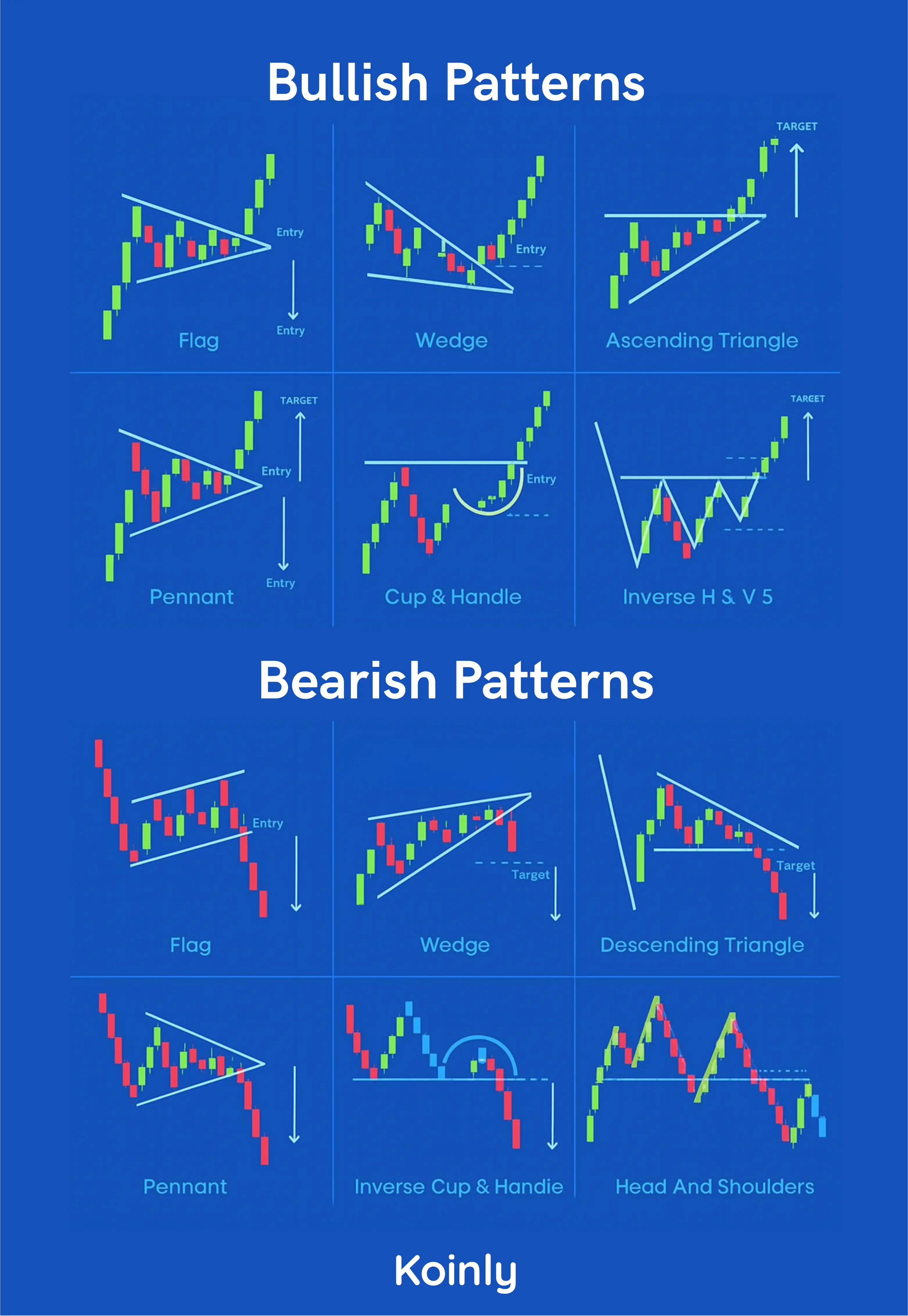
Crypto chart patterns cheat sheet
Want an easy way to reference different chart patterns? Check out our crypto chart patterns cheat sheet.
Use Koinly to track your portfolio
Crypto charts aren’t the only tools available to manage your investment portfolio. A read-only access portfolio tracker like Koinly, that also works as a crypto tax calculator, can help you manage your investments as well as your tax bill.
Koinly can help you keep track of your portfolio performance, including tracking realized and unrealized gains, and best of all, come tax time, Koinly can generate your tax reports for you. Sign up for free.